
Why Choose a Rodless Pneumatic Cylinder?

Time:2026-11-03 Author:Oliver
0%

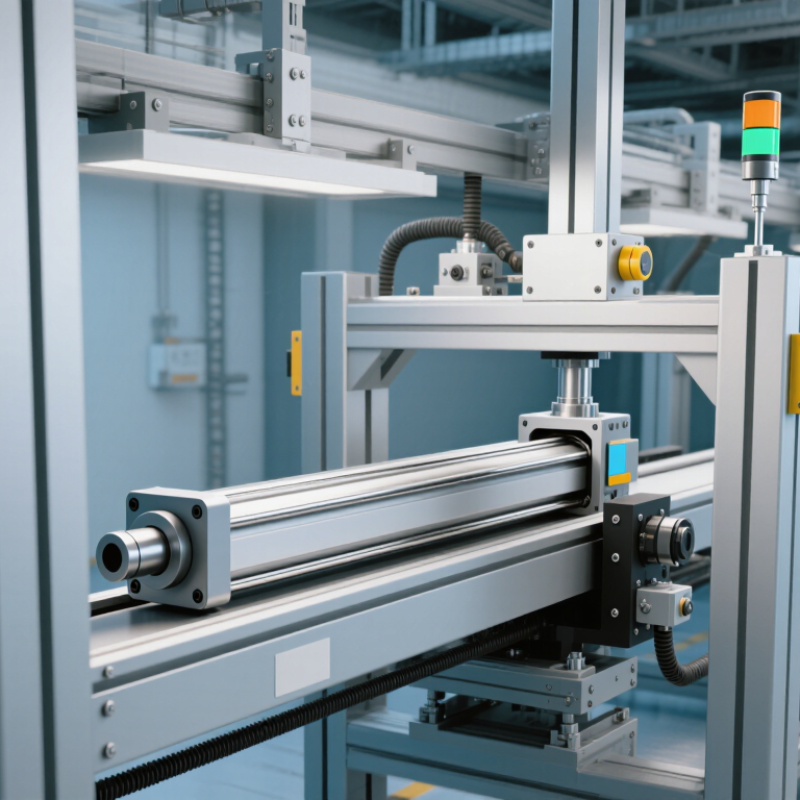
In a machine with limited room, a conventional cylinder’s extending rod can become an awkward obstacle. A Rodless Pneumatic Cylinder moves its carriage along the cylinder body, so it can provide a long stroke without requiring equal space for a projecting rod. That difference is visible on a packaging line: the carriage can travel beside a guide rail while nearby frames and sensors remain in place. Space matters.

Rodless cylinders commonly use a mechanical band or magnetic coupling to connect the internal piston with the external carriage. Each design has practical limits, so selection should reflect the load, stroke, speed, mounting orientation, and operating environment. Check the manufacturer’s rated side load and moment capacity, too. A long carriage may need external guidance, especially when the load is uneven or offset. Small details matter.

The benefits are not automatic. Air consumption, cushioning, contamination, and maintenance access can affect performance over time. A magnetic coupling may suit some applications, while a mechanically connected design may better match others. The right choice depends on verified specifications and the machine’s actual duty cycle, not just a compact product description. It is easy to focus on saved space and overlook alignment. That deserves a second look. This guide explains where rodless pneumatic cylinders can help, what trade-offs to assess, and which selection details deserve attention before installation.
Why Choose a Rodless Pneumatic Cylinder?

What Is a Rodless Pneumatic Cylinder and How Is It Constructed?

A rodless pneumatic cylinder produces straight-line motion without a piston rod extending from its body. A piston moves inside a long tube as compressed air enters through ports at either end. The piston’s movement transfers to an external carriage that carries a tool, gripper, or workpiece. This arrangement can reduce the space needed at the cylinder’s ends. Useful in tight layouts.

Two common designs transfer motion differently. In a mechanically coupled model, the piston connects to the carriage through a longitudinal slot in the tube. Sealing bands help keep air inside while allowing the connection to travel. In a magnetically coupled model, magnets in the internal piston attract magnets in the external carriage through the tube wall. There is no continuous open slot, though the load and operating conditions still matter.

The main parts include the tube, piston, seals, end caps, air ports, and carriage. Some versions add guide rails to support loads and limit unwanted rotation. That detail is easy to overlook: the cylinder may move a load, but it should not automatically be treated as its sole support. Seal wear, side forces, and alignment can affect performance. A slightly misaligned carriage may still run, but it can wear unevenly over time.

How Do Mechanical and Magnetic Couplings Transfer Linear Motion?

A rodless pneumatic cylinder transfers motion without a piston rod extending beyond the tube. In a mechanically coupled design, the piston connects to an external carriage through a longitudinal slot. As compressed air moves the piston, the carriage travels along the cylinder, carrying the attached load. Sealing bands help limit air leakage and keep debris out, but the slot and seals need inspection. Small wear matters.

A magnetic design uses magnets inside the piston and in the external carriage. Their attraction transfers movement through the cylinder wall, so there is no longitudinal opening. This can simplify sealing and help in clean or space-limited installations. But magnetic force has limits: a sudden heavy load or excessive acceleration may separate the couplings. Check load, speed, and stopping conditions against the cylinder’s rated capacity. The U.S. Department of Energy’s Improving Compressed Air System Performance sourcebook notes that compressed air can account for about 10% of industrial electricity use, and more in some facilities. Efficient sizing matters.

Tips: Watch carriage motion under real load. A little hesitation can reveal misalignment or a coupling near its limit. I would not assume the cleaner-looking option is automatically better; mounting access and maintenance habits matter, too.

How Far Can They Travel? Some Models Offer Strokes up to 6,000 mm

Why Choose a Rodless Pneumatic Cylinder?
How Far Can They Travel? Some Models Offer Strokes up to 6,000 mm

A rodless pneumatic cylinder can move a carriage along its body without a piston rod extending from the end. That design can be useful when a machine needs a long, straight movement but has limited space at each end. Some models offer strokes up to 6,000 mm, making them suitable for tasks such as transferring materials across a wide work area. That matters. Still, maximum stroke is not the only measure of a good fit.

Longer travel can bring practical trade-offs. The load, speed, mounting orientation, and required positioning accuracy all affect performance. A carriage carrying a small sensor behaves differently from one moving a heavy fixture. Check the manufacturer’s load and moment ratings, air-pressure range, and installation guidance for the exact model. A long cylinder may also need careful support and alignment. It sounds straightforward, but small mounting errors can cause uneven movement or extra wear.

Tips: Measure the full travel and available mounting space before selection. Confirm the moving load, including brackets and tools. Leave room for tubing and end connections, too. If the application needs precise stops, check whether the cylinder alone can provide them. It may not.

Why Choose a Rodless Pneumatic Cylinder?

Some models offer strokes up to 6,000 mm.

Rodless cylinders can provide long linear travel without a piston rod extending beyond the cylinder body. The 6,000 mm figure is an upper value for some models; the suitable stroke depends on the specific cylinder design and application.

How Does Bore Size Affect Force? A 32 mm Bore at 6 bar Produces About 483 N

Why Choose a Rodless Pneumatic Cylinder?

How Does Bore Size Affect Force? A 32 mm Bore at 6 bar Produces About 483 N

A cylinder’s bore determines the piston area that compressed air can push against. For a 32 mm bore, the piston area is about 804 mm². At 6 bar gauge pressure, or 600,000 pascals, the theoretical force is roughly 483 N. That is the ideal figure. It assumes full pressure reaches the piston and ignores friction, seal drag, and pressure losses in valves or tubing.

In a rodless cylinder, this force moves a carriage along the barrel, making the design useful when a long stroke must fit into limited space. But 483 N should not be treated as the safe working load. Real output is lower, and acceleration, carriage guidance, mounting position, and cushioning all matter. A horizontal load may behave very differently from a vertical one. Check the load. Then allow a sensible margin, rather than sizing the bore from a single calculation. It is easy to focus on peak force and overlook the effect of speed or side loading; that part deserves a second look.

Why Choose Rodless Cylinders for Space-Constrained, Long-Stroke Automation?

In a compact machine, a conventional cylinder may need nearly twice its stroke length for the rod to extend. A rodless pneumatic cylinder moves its carriage along the cylinder body instead, making long travel possible within a shorter linear footprint. Space matters. This can free room beside a packaging conveyor, inspection station, or parts-transfer line.

That advantage is useful when a gripper must travel several hundred millimeters between two points. The cylinder stays in place while its carriage carries the load, and mounting it parallel to a frame can simplify a tight layout. A practical detail: the carriage still needs clearance for fittings, sensors, and maintenance. A design that fits on a drawing may be awkward to service in a guarded machine.

Rodless cylinders are not a cure for every space problem. Check the moving load, stroke, speed, and moment forces against the cylinder’s ratings. Long carriages may need external guides to control side loads, especially when handling an offset payload. Consider the environment, too: slot-type designs may need protection from dust, while magnetically coupled designs can have different force limits. That trade-off is easy to miss. Measure the full travel envelope and review stopping distance before choosing a model; compact packaging is valuable, but reliable motion depends on the whole installation.

FAQS

How far can a rodless pneumatic cylinder travel?

Some models offer strokes up to 6,000 mm. Actual travel depends on the model and application. Check its specifications.

Why choose a rodless cylinder for a tight machine layout?

Its carriage travels along the cylinder body, without a rod extending from the end. That can save space beside a conveyor or inspection station. Space matters.

What should I measure before selecting one?

Measure the full travel and mounting space. Include brackets, tools, tubing, and end connections. A drawing can miss awkward service access.

Does a longer stroke always mean better performance?

No. Load, speed, mounting direction, and positioning needs matter too. Longer travel may require extra support and careful alignment.

Can a cylinder move a heavy or offset load?

Check the exact model’s load and moment ratings. An offset fixture can create side forces. External guides may be needed.

Will the cylinder stop precisely at any position?

Not necessarily. Check whether the cylinder alone can provide the required stops. Review stopping distance and positioning needs.

Do different designs need different protection?

Yes. Slot-type designs may need protection from dust. Magnetically coupled designs can have different force limits. I might overlook this detail, but it matters.

Conclusion

A Rodless Pneumatic Cylinder creates linear motion without a piston rod extending from the cylinder body. Instead, a carriage moves along the cylinder as compressed air drives an internal piston. Depending on the design, mechanical or magnetic coupling transfers the piston’s movement to the external carriage. This arrangement keeps the actuator compact while allowing it to handle long travel distances; some models can provide strokes of up to 6,000 mm.

The cylinder’s bore size and operating pressure determine the force it can produce. For example, a 32 mm bore operating at 6 bar generates approximately 483 N, before accounting for practical losses. With its space-saving profile and long-stroke capability, a rodless cylinder can be a useful choice for automation systems where a conventional rod-style actuator would require excessive room or additional support.

Oliver

Oliver

Oliver is a seasoned marketing professional with a wealth of expertise in driving brand awareness and engagement. With a deep understanding of our company's product offerings, he consistently delivers high-quality content that enriches our professional blog. His insights not only shed light on......