
Choosing the right Pneumatic Piston Cylinder is not simply a matter of matching bore size and stroke length. The cylinder must suit the load, speed, pressure, duty cycle, mounting position, and surrounding environment. A compact actuator may look efficient on a machine drawing, yet stall when friction rises or air pressure drops during peak demand.
The U.S. Department of Energy reports that compressed air can represent 10% to 15% of industrial electricity use, while leaks may waste 20% to 30% of compressor output. These figures make actuator efficiency more than a technical detail. Correct sizing, shorter air lines, suitable seals, and controlled exhaust can reduce avoidable energy loss. The ISO 15552 and ISO 6432 standards also provide useful dimensional references, helping engineers compare cylinders from different manufacturers with greater confidence.
Real conditions remain less tidy. A catalog force table assumes stable pressure and ideal loading. Production floors rarely behave that way. Dust, side loads, condensation, misalignment, and frequent cycling can shorten service life. MarketsandMarkets and other industrial automation reports continue to identify pneumatic systems as important in factory automation, but market growth does not remove basic selection risks. A reliable decision should combine manufacturer data, hands-on inspection, and realistic operating calculations. Do not size by force alone. Check cushioning, rod buckling, sensor compatibility, maintenance access, and spare-part availability. Sometimes, a slightly larger cylinder is safer; sometimes, it only hides poor design. That judgment deserves careful review.
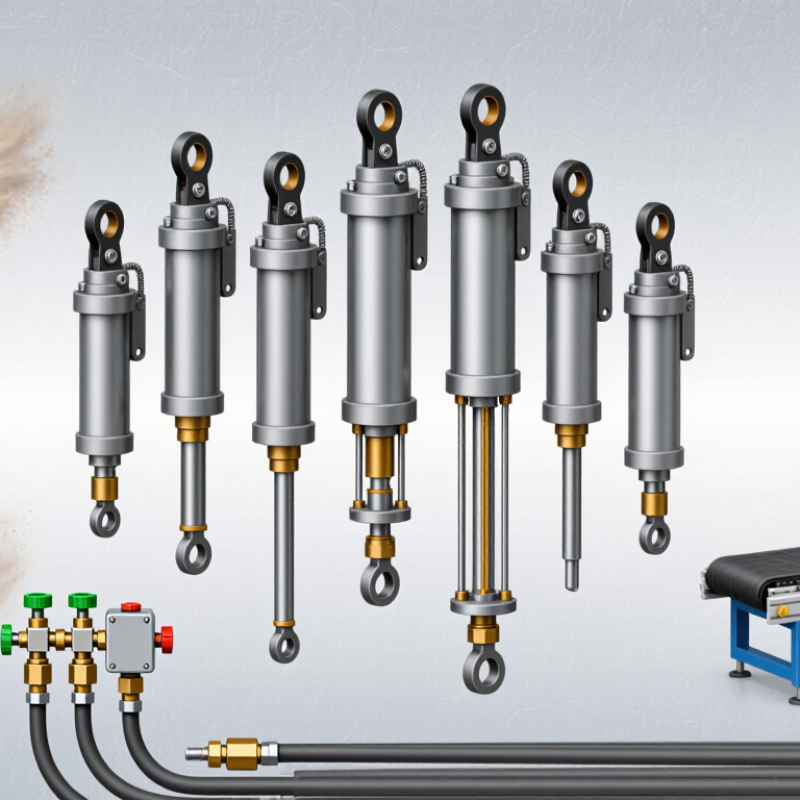
Choosing a pneumatic piston cylinder starts with its operating principle, not its appearance. Compressed air enters a chamber and pushes a sealed piston. The piston transfers force through a rod or carriage. Exhaust air leaves through the opposite port.
Single-acting cylinders use air for one stroke and a spring for return. They suit clamps, ejectors, and short, low-load movements. Double-acting cylinders use air on both sides of the piston. They provide controlled extension and retraction. Rodless cylinders move a carriage along the barrel, saving space in long travel applications. Guided cylinders resist twisting when loads are offset. Compact cylinders fit tight layouts, but their shorter bodies can limit stroke length.
Cylinder selection should match load, stroke, speed, and installation direction. A useful estimate is force equals pressure multiplied by piston area. Rod diameter reduces the return-side area, so extension and retraction forces are rarely identical. Check the actual working pressure, not only the advertised maximum. Add adjustable cushioning when the piston stops quickly or carries a heavy load. I have seen machines shake because cushioning was ignored during early design. That mistake is easy to repeat. Air quality matters too; water and poor lubrication can damage seals. In practice, a slightly larger cylinder may improve reliability, but oversizing wastes air and can make motion harsh. Port size, mounting hardware, sensor access, and replacement space also deserve attention. The best type is the one that delivers stable movement under real operating conditions.
Understanding pneumatic piston cylinder types and operating principles begins with estimating the force required for the application. The chart below shows theoretical extension and retraction forces at 6 bar gauge pressure for representative bore and rod sizes.
Operating principle: A single-acting cylinder uses compressed air for one stroke and a spring or external load for the return stroke. A double-acting cylinder uses compressed air for both extension and retraction, providing better control and a higher usable cycle rate. Retraction force is lower because the piston rod reduces the effective piston area.
Calculation basis: Theoretical force = pressure × effective piston area. Values are calculated at 6 bar gauge pressure and exclude friction, cushioning losses, pressure drops, and load variations. Select a cylinder with additional force capacity for reliable operation.
Choosing a pneumatic piston cylinder starts with the real load, not the catalog rating. Measure the moving mass, friction, and any sideways resistance. A vertical load also needs allowance for gravity. In practical installations, I have seen cylinders stall because designers ignored guide friction. It looked minor. It was not. Use external guides when the piston rod should not carry bending loads.
Speed and stroke must match the machine cycle. Calculate the required speed from stroke length and available motion time. Then check whether the air supply can maintain that speed under actual pressure. A long stroke may need cushioning near the end position. Without it, the piston can strike harshly and create vibration. Force requires more than basic pressure calculations. Use the effective piston area, subtract rod-side area during retraction, and include a safety margin. A rough estimate can work during early planning, but it should not control final selection.
Tips: Record load changes during the full cycle, not only at startup. Test the cylinder at the lowest expected air pressure. Confirm the stroke includes clearance for tools, seals, and adjustment. Avoid choosing the highest available force without checking speed and energy. More force can mean slower movement, louder impact, and unnecessary air use. Recheck the design if the load is uneven or the motion is angled. Small assumptions often become expensive corrections.
Selecting Bore Size, Rod Design, and Mounting Configuration
Choosing a pneumatic piston cylinder starts with the real load, stroke, and operating speed. Bore size determines pushing force, while air pressure affects the available output. Calculate force with a safety margin, but account for pressure losses and friction. A first estimate can be wrong. Test the cylinder under actual temperature and duty conditions before final selection.
Rod design deserves equal attention. Rod diameter must resist buckling during compression strokes, especially with long extensions. Side loads should be handled by external guides, not by the cylinder rod. I have seen premature seal wear when a rod supported a misaligned slide. A thicker rod is not always better. It can increase weight and slow the machine. Consider thread size, retraction space, corrosion exposure, and the required cushioning method.
Mounting configuration controls alignment and service life. Clevis mounts allow angular movement, while flange mounts provide firm positioning. Trunnion mounts suit pivoting applications, but their pivot axis must match the machine geometry. Foot mounts work well on fixed frames, though poor alignment can transmit vibration into the cylinder. Leave access for fittings, sensors, and seal replacement. In practice, a flexible mount may solve movement problems better than a stronger frame. Recheck the layout after installation. Small alignment errors often become expensive failures.
How to Choose a Pneumatic Piston Cylinder
Matching materials to the workplace prevents premature cylinder failure. Aluminum suits clean indoor machinery because it is light and easy to install. Stainless steel is safer near washdown areas, salt spray, or chemical mist. Check the rod material too. A strong tube cannot compensate for a corroded rod. I once saw a cylinder seize because the housing was protected, but the exposed rod was ignored.
Seal selection depends on temperature, fluid contact, speed, and pressure. Polyurethane seals handle many general applications and resist wear during frequent cycling. Nitrile seals work well with ordinary compressed air and moderate temperatures. Fluorocarbon compounds may suit higher heat or aggressive environments, but they can lose flexibility when cold. The catalog rating is not enough. Measure the actual temperature beside the cylinder, not only inside the control cabinet.
Air quality quietly controls service life. Use filtration that matches the manufacturer’s cleanliness requirement, and drain the receiver regularly. Wet air can corrode internal surfaces and wash lubricant from sealing edges. Excess oil is not always helpful. Some modern seals need only clean, dry air. Operating conditions complete the choice: calculate thrust from bore area and pressure, then allow for friction and side loads. Confirm stroke length, retraction speed, cycle frequency, and mounting alignment. A cylinder rated for 10,000 cycles may perform poorly under continuous side loading. I still prefer a short field trial, because real dust, vibration, and imperfect alignment often challenge a perfect calculation.
| Selection Dimension | Operating Condition or Requirement | Recommended Cylinder Materials and Seals | Typical Technical Guidance | Selection Notes |
|---|---|---|---|---|
| Cylinder Body | General industrial automation in a clean, dry indoor environment | Anodized aluminum barrel with carbon-steel or stainless-steel rod | Aluminum offers low mass and good corrosion resistance. A plated or stainless-steel rod helps resist surface wear. | Suitable for assembly equipment, packaging machinery, material handling, and light manufacturing. |
| Cylinder Body | High humidity, washdown, coastal air, or mildly corrosive surroundings | Stainless-steel body and rod; use corrosion-resistant fasteners | Stainless construction reduces rust risk where water, salt, or cleaning chemicals may contact external surfaces. | Confirm the exact stainless-steel grade and chemical compatibility before use in aggressive environments. |
| Cylinder Body | Food, beverage, or hygienic processing area | Smooth stainless-steel construction with hygienic geometry and suitable food-contact lubricants | Choose designs that minimize dirt traps and tolerate the site’s cleaning temperature, pressure, and chemical concentration. | The cylinder itself may be suitable for washdown, but the complete installation must also meet the applicable hygiene requirements. |
| Piston Seal | Standard ambient temperature and general-purpose compressed air | Nitrile rubber (NBR) or polyurethane seal | NBR commonly supports approximately −20 to 80 °C; polyurethane provides good abrasion resistance but must be checked for temperature and chemical limits. | Actual limits depend on compound, lubrication, speed, pressure, and the seal manufacturer’s design. |
| Piston Seal | Elevated temperature or exposure to many oils and chemicals | Fluorocarbon rubber (FKM) or another application-specific high-temperature compound | FKM is often selected for higher-temperature and chemical-resistance requirements; typical limits may approach 150 °C in suitable designs. | FKM is not automatically suitable for every chemical, low-temperature condition, steam application, or dynamic service. |
| Rod Seal | Frequent reciprocating motion and moderate contamination | Wear-resistant polyurethane or NBR rod seal with an external wiper | The rod seal retains pressure while the wiper helps prevent dust, moisture, and particles from entering the cylinder. | A separate scraper or bellows may be needed where abrasive dust, welding spatter, or liquid spray is present. |
| Static Seals | Normal pressure and temperature fluctuations | NBR O-rings for standard service; FKM O-rings for higher temperature or chemical exposure | Static seal selection should consider compressed-air additives, ambient temperature, cleaning agents, and the mating materials. | Avoid choosing seal material based only on nominal temperature; dynamic movement and chemical exposure also affect service life. |
| Compressed-Air Quality | General industrial service with lubricated or non-lubricated components | Filtered, regulated, and adequately dried compressed air | Use a filter-regulator and drain condensate. A common general-purpose target is ISO 8573-1 solid particle and water classes appropriate to the equipment. | Follow the cylinder and valve manufacturer’s air-quality specification; excessive water and particles accelerate seal and bore wear. |
| Compressed-Air Quality | Clean, non-lubricated operation | Use oil-free or properly treated air and seals approved for non-lubricated service | Many modern cylinders can operate without added oil when the design is specified for this condition and the air is clean and dry. | Do not introduce oil after commissioning unless the complete pneumatic system is approved for lubricated operation. |
| Operating Pressure | Typical factory automation | Select a cylinder rated above the maximum regulated supply pressure | Many pneumatic cylinders operate in the approximate 1 to 10 bar gauge range, but the allowable range is product-specific. | Size using the lowest available working pressure and verify pressure losses, safety factors, and end-of-stroke loads. |
| Force Requirement | Linear pushing or pulling load | Choose bore diameter from theoretical force, then apply a practical efficiency factor | Extension force: F = P × πD² ÷ 4. Retraction force: F = P × π(D² − d²) ÷ 4, where P is pressure, D is bore diameter, and d is rod diameter. | Allow for friction, acceleration, external resistance, pressure variation, and a suitable safety margin. Theoretical force is not the usable output force. |
| Stroke Length | Required travel of the machine mechanism | Select a stroke slightly longer than the effective travel, while avoiding unnecessary excess length | Longer strokes increase rod deflection, buckling risk, side-load sensitivity, and overall installation space. | Use external guides for side loads instead of relying on the cylinder rod to guide the moving assembly. |
| Speed Control | Controlled extension and retraction | Use meter-out flow control for most pneumatic cylinder applications | Meter-out control generally provides more stable motion because exhaust flow is restricted while supply pressure remains available to drive the piston. | Use cushioning or adjustable end-of-stroke damping where the piston must decelerate before reaching the cap. |
| Temperature | Cold, normal, or elevated ambient conditions | Match barrel, lubricant, and seal compound to the complete temperature range | Standard seal systems often cover approximately −20 to 80 °C, while specialized systems may extend beyond this range. | Low temperature can harden seals; high temperature can reduce seal life and alter lubricant viscosity. Verify both ambient and process temperatures. |
| Side Load and Alignment | Offset loads, unsupported tooling, or bending forces | Use external linear guides, spherical rod ends, or guided-cylinder designs | Pneumatic cylinders are primarily intended to provide axial force, not to support substantial radial or bending loads. | Misalignment increases rod, bearing, and seal wear and may cause leakage or premature failure. |
| Environment | Dust, fibers, abrasive particles, or outdoor exposure | Select protective rod wipers, corrosion-resistant surfaces, and suitable environmental shielding | Protection should address both contamination entering along the rod and corrosion of exposed metal surfaces. | For severe contamination, consider bellows, positive-pressure protection, or a cylinder design specifically intended for harsh service. |
| End-of-Stroke Impact | High mass, high speed, or frequent cycling | Use adjustable pneumatic cushioning, shock absorbers, or external mechanical stops | Energy at impact increases with moving mass and the square of velocity, so stopping requirements should be evaluated before final selection. | Mechanical stops should not transfer excessive shock into the rod, piston, or mounting structure. |
| Duty Cycle | Continuous or high-frequency cycling | Select low-friction seals, adequate guidance, clean air, and a cylinder rated for the expected cycle frequency | Cycle life depends on speed, pressure, stroke, side load, lubrication, air cleanliness, temperature, and end-of-stroke impact. | Validate the selection with a representative endurance test when failure would affect safety, production, or product quality. |
A suitable pneumatic piston cylinder must protect people, equipment, and production time. Start with the actual load, stroke length, operating speed, and available air pressure. Never size it from force alone. Side loading, poor alignment, and sudden stopping can shorten service life. Select a cylinder with a suitable safety margin and confirm its rated pressure against your documented risk assessment. Guards, emergency stops, and controlled exhaust are equally important. A powerful cylinder can still create a dangerous pinch point.
Maintenance needs directly influence total ownership cost. Check whether seals, guide components, and mounting parts are easy to inspect and replace. Clean, dry air reduces corrosion and internal wear. A simple filter inspection can prevent expensive downtime. Record cycle counts, leakage, noise, and changes in movement. I once underestimated alignment problems because the cylinder moved smoothly during a short test. After several weeks, the rod and seals showed uneven wear. That mistake changed how I evaluate installations.
Tips: Compare purchase price with air consumption, replacement parts, labor, and lost production hours. Ask for service intervals and realistic seal-life information. Test for leakage with the machine stopped and pressurized safely. Keep spare seals only when storage conditions are controlled. Avoid choosing the smallest cylinder to save money; higher operating pressure may erase that saving. Also question unusually long maintenance claims. Actual dust, moisture, temperature, and cycle frequency can differ from laboratory conditions. Include disposal and energy costs in the ownership calculation.
Start with the real load, stroke, speed, and available air pressure. Calculate force with a safety margin. Include friction and pressure losses. A first estimate may be wrong. Test the cylinder under actual temperature and duty conditions.
The rod must resist buckling during compression strokes. This matters more with long extensions. A thicker rod is not always better. It may add weight and slow the machine. Check thread size, retraction space, and corrosion exposure.
Do not rely on the rod for side loading. Use external guides for misaligned slides. Side loads can damage seals and guide components. I once overlooked this detail. The cylinder moved smoothly, but uneven wear appeared weeks later.
Clevis mounts allow angular movement. Flange mounts provide firm positioning. Trunnion mounts suit pivoting applications. Their pivot axis must match the machine geometry. Foot mounts work well on fixed frames. Poor alignment can transmit vibration.
Recheck the layout after installation. Confirm the rod, load, and mounting points remain aligned. Leave access for fittings, sensors, and seal replacement. Small errors can become expensive failures. Movement should remain smooth throughout the stroke.
Do not size the cylinder from force alone. Consider side loads, sudden stopping, and pinch points. Use suitable guards, emergency stops, and controlled exhaust. Confirm rated pressure against the documented risk assessment. Powerful movement can still be hazardous.
Use clean, dry air to reduce corrosion and internal wear. Inspect filters regularly. Record cycle counts, leakage, noise, and movement changes. Check seals and guide components for wear. Short tests can hide long-term problems.
Compare purchase price with air consumption, replacement parts, labor, and lost production time. Include energy and disposal costs. Ask for realistic service intervals. Actual dust, moisture, temperature, and cycle frequency may differ from testing conditions. Do not trust unusually long maintenance claims without evidence.
Choosing the right Pneumatic Piston Cylinder begins with understanding how different cylinder types operate and how they convert compressed air into controlled linear motion. Define the application’s load, required speed, stroke length, and force before selecting a suitable cylinder. Bore size should provide sufficient force without unnecessary air consumption, while rod design must withstand side loads, bending, and repeated movement. The mounting configuration should also align with the available space and motion path.
Material selection, seal compatibility, air quality, temperature, humidity, and exposure to dust or chemicals all influence reliability and service life. Consider filtration, lubrication requirements, and proper air pressure control to support stable operation. Safety features, ease of inspection, replacement-part availability, and maintenance access are equally important. Finally, evaluate the total ownership cost, including energy use, installation, downtime, and expected service life, rather than focusing only on the initial purchase price.
